
- REEDOME
- The dome guide
- Stage 2: Understand
- 1. Discover
- 2. Understand
- 3. Decide
- 4. The path
An A++ dome: warmth, ventilation and running costs
 Visualisation
help@reedome.eu
+370 [JŪSŲ NUMERIS]
VisualisationAn energy class can look like just a letter on a certificate. In fact it tells you how much energy a house needs, where that energy comes from and how it feels to live in: whether it is draughty, whether the air is fresh, whether it overheats in summer. Here is what A++ means and how a dome reaches it.
Lithuania rates buildings in nine energy performance classes, from A++ down to G. The requirements are set by the technical construction regulation STR 2.01.02:2016, and A++ is the highest class. New buildings whose building permit application was submitted after 1 January 2021 must, with some exceptions, meet it.
Class A++ corresponds to the EU idea of a nearly zero-energy building: the house needs very little energy, and most of it comes from renewable sources. For homes, a few requirements matter most:
The EU has already agreed the next step: from 2030, all new buildings are to be zero-emission, with national rules still to follow. Norway, Poland and the Netherlands use their own rating scales, but the principles below apply everywhere.
A house loses heat through its outer surface, so the less surface it has for a given volume, the easier it is to heat. A dome is one of the most compact shapes: compared with a long single-storey house, its outer surface is considerably smaller. Against a compact cube the difference is smaller, so the shape is an advantage, not a miracle.
A dome also has no wall-to-roof junction, a common source of thermal bridges in conventional houses: its shell runs unbroken from foundation to crown.
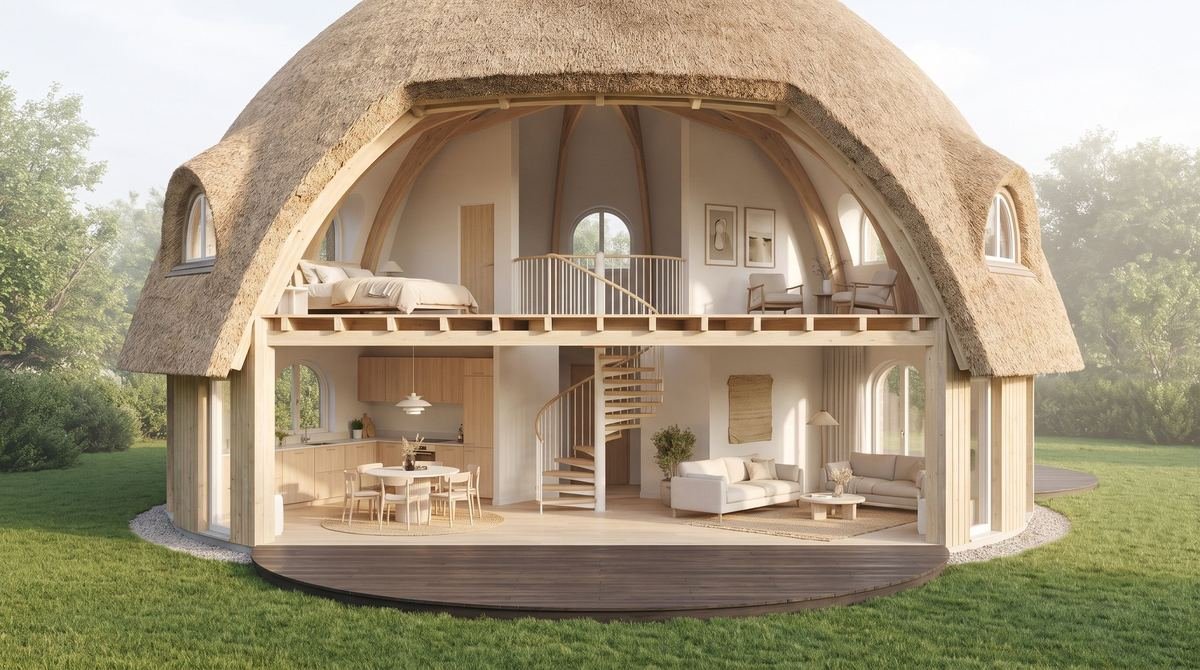
In a REEDOME dome, the layer of wood fibre or cellulose insulation is up to 30 cm thick, with another 30–35 cm of reed above it. These natural materials keep heat in during winter and, thanks to their high heat capacity, slow the heat coming in during summer.
Wood fibre and cellulose can also absorb moisture and release it again, which helps keep the structure at a steady moisture level. The vapour control layer on the inside limits moisture entering the structure, while the diffusion membrane on the outside lets it escape.
An A++ house has to be airtight. Every gap that lets warm air out and cold air in means heat loss, draughts and a risk of moisture in the structure.
Airtightness comes from a continuous sealing layer on the inside of the shell, carefully taped joints and well-planned points where pipes and cables pass through. The final test shows the result, and an interim test during construction is worthwhile, while the walls are open and leaks are easy to fix.
Air in an airtight house does not change by itself, so it needs a ventilation system. A heat-recovery unit continuously extracts damp, stale air from the kitchen and bathrooms and supplies fresh, filtered air to the bedrooms and living space.
The point is the heat recovery: warm outgoing air passes through a heat exchanger and warms the cold incoming air without the two mixing. In summer the system can bypass the exchanger, so that cooler night air comes straight in. The filters need changing regularly, a routine part of home upkeep.
A heat pump takes heat from the outside air or the ground and, using electricity, moves it into the house. Each kilowatt-hour of electricity delivers several times as much heat, and the heat drawn from the surroundings counts as renewable energy.
A low-energy house needs only low-temperature heating, so a heat pump works best with underfloor heating. It usually heats the hot water too, and with solar panels on the ground or on an outbuilding roof, the house can produce part of its own electricity.
A well-insulated house also needs protecting from overheating. In a dome the shell itself helps: the reed holds off direct sun, and the thick natural insulation lets heat through slowly.
Most summer heat comes in through the glazing, especially the skylight at the apex. Window sizes and orientations are planned with shading, and it is worth making the skylight or high windows openable, since warm air gathers at the top and can escape there naturally. Some heat pumps can provide gentle cooling through the floor.
Running costs depend on more than the house itself, so no single figure fits everyone. The main factors are:
REEDOME domes are designed for energy class A++, with up to 30 cm of natural insulation, an airtight shell, a heat pump and heat-recovery ventilation. During the design we choose the heating and ventilation with you, so that they suit your plot and the way you live. If you would like to talk it through, fill in our questionnaire and we will be in touch.
Fill in a short questionnaire. We'll answer your questions and suggest where to start.