
- REEDOME
- The dome guide
- Stage 3: Decide
- 1. Discover
- 2. Understand
- 3. Decide
- 4. The path
What drives the price of a dome home
 Visualisation
help@reedome.eu
+370 [JŪSŲ NUMERIS]
Visualisation"How much does a dome home cost?" is the first question we hear, and the honest answer is that it depends. Not because we want to keep it from you, but because two houses of the same size on different plots, with different finishes, can cost very different amounts. This article explains what drives the price and which factors weigh most.
Size has the biggest influence: the larger the dome, the more frame, reed, insulation and finishing it needs. A mezzanine covering about a third of the floor adds square metres while barely enlarging the foundations or the shell.
When you need more space, you can choose one larger dome or several joined together. Two domes linked by a glass gallery, as in the Residence model, give more privacy and light, but they have more outer surface and more junctions, so they usually cost more than a single dome of the same floor area.
Some costs hardly depend on size at all. The surveyor, design, permits, site set-up, utility connections, heat pump, ventilation unit and kitchen are needed whether the house is small or large.
In a bigger house, these costs are spread over more floor area. A taller dome also has room for a mezzanine, so usable area grows faster than the shell. That is why a square metre of a small retreat dome usually costs more than one of a large family home, even though the total is of course lower.
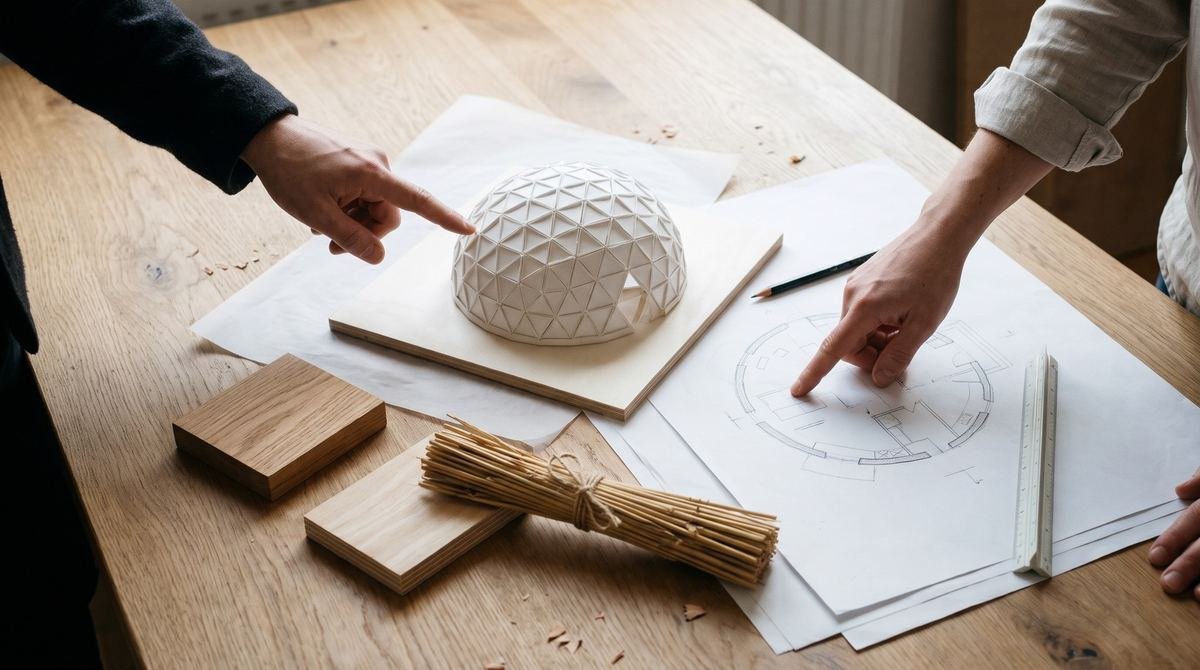
The frame of the dome is made of glued-laminated timber triangles, prepared in advance from a digital model and assembled on site within a few weeks. Precise prefabrication and a short assembly reduce the risk of surprises on site.
A large share of the shell's cost lies in the hand-laid reed and the thick natural insulation. These are the layers that do most to make the house warm and long-lived.
A level plot with firm ground and easy access is the simplest case. A slope, a high water table, peat or weak soil can call for more complex foundations, which changes the price noticeably.
Access matters too. If heavy machinery and delivery lorries cannot reach the site, a temporary road or another workaround is needed. That is why a plot is worth assessing before you buy it.
Electricity, water and sewer networks close by make the work much simpler. The further away they are, the more a connection costs, and sometimes a private borehole and an on-site wastewater treatment unit are the cheaper option.
The cost of an electricity connection also depends on the capacity you need. A heat pump, an induction hob, a sauna or an electric car charger all require more power, so it is worth working this out early.
A square metre of window costs considerably more than the same area of insulated wall. In a geodesic dome the windows are triangular and made to measure, and an A++ house needs very well-insulated glazing units.
More glass brings more light and views, but also a higher price and a greater need for summer shading. A skylight at the apex or a glass gallery between domes are striking features that affect the price more than a few extra windows.
The same dome can look very different inside. REEDOME offers three finish levels:
The difference between levels comes not only from the cost of materials but from labour. Natural stone, lime plaster and intricate built-in joinery all take more of a craftsman's time.
The kitchen, built-in furniture, bathroom fittings, lighting and sauna can make up a sizeable share of the budget. In a dome, people often choose furniture made to fit the curve, because it makes the best use of the walls, but it costs more than standard pieces.
This is the easiest part to adjust. Some decisions can wait until later, with only the essentials fitted at the start.
Terraces, paths, a driveway, fencing, planting, an outbuilding or an outdoor sauna are often left out of first estimates. Surroundings matter especially for a dome set in nature, so they belong in the budget from the start, even if you carry them out in stages.
Before building begins, you need a surveyor, a design, engineering and permits. On top of that come the energy performance certificate and, for an A++ house, the mandatory airtightness test. These costs are a smaller share of the budget, but they cannot be avoided, and their quality decides whether there are surprises later.
In short, size and finish level usually have the greatest effect on the price. The plot and utilities can move it significantly in either direction, so they are worth assessing first. Design and permits are a smaller share, but they decide how smoothly the whole journey goes.
Because every plot and every family is different, we work out each price individually. After the questionnaire and a conversation we discuss your needs and budget, and once the design is ready we give you a detailed estimate covering the whole journey: surveyor, architect, permits, construction and interior, since we handle all of it ourselves. If you would like to know what your dome would cost, start with our short questionnaire.
Tell us about your future dome and get a tailored proposal.