
- REEDOME
- The dome guide
- Stage 3: Decide
- 1. Discover
- 2. Understand
- 3. Decide
- 4. The path
A plot for a dome: what to check before buying
 Visualisation
help@reedome.eu
+370 [JŪSŲ NUMERIS]
VisualisationA plot decides more than the view from your window. It determines whether a dome can be built at all, how much the foundations and utilities will cost, and how it will feel to live there. Most things are far easier to check before you buy than to fix afterwards.
Start with the plot's entry in the land register. In Lithuania, the Real Estate Register extract shows the plot's main land use purpose and its permitted use. The simplest case for a house is land designated for "other" use (kitos paskirties žemė) with the permitted use "single- and two-dwelling residential areas".
On agricultural land a house can sometimes be built, but only in particular cases and through extra procedures, such as a farmstead under a land management project or a change of the plot's purpose. That takes time and depends on the municipality's planning documents, so a plot like this is worth assessing before you sign anything.
It also matters what the municipality's general plan and, where one exists, the detailed plan say about the plot. They may set how much of the plot can be built on, how tall buildings may be and which architectural requirements apply. For a dome, it is especially worth checking whether a particular roof shape or material is prescribed.
Many plots carry special land use conditions: restrictions on economic and other activities that the law sets for certain areas. In Lithuania these are recorded in the Real Estate Cadastre and Register, so the first signs appear in the same extract. They can arise from a road, a power line, a gas pipeline, a heritage site or a body of water.
Plots near lakes, rivers and ponds deserve particular care. Along bodies of water the law sets a shoreline protection strip and a wider protection zone. Earthworks and changes to the shoreline are prohibited in the strip, and in the zone there are limits on how close to the strip new buildings may stand, with exceptions for towns and compact villages.
If the plot lies in a national or regional park, a nature reserve or another protected area, additional management and protection requirements may apply. They can affect not only whether you may build, but also the size, shape or materials of the building. These rules depend on the specific area, so we check them plot by plot.
Check that the plot can be reached not only in practice but also legally. If the road crosses a neighbour's land, there should be a registered right of way (in Lithuania, a servitude). Otherwise a friendly arrangement today can become a problem later.
It also matters whether construction vehicles can get there. Frame components, bundles of reed and other materials arrive by lorry, so a narrow track or a gravel road that turns to mud in spring can make building slower and more expensive. Think about winter too: who clears the snow, and how quickly.
Find out where the nearest electricity, water and sewerage networks are. The network operators set the conditions for connecting to them, and the distance to the networks feeds directly into the cost. Sometimes a private borehole or an on-site wastewater treatment system can replace part of the networks, but these also need space and approvals.
Don't forget what may look like a detail: mobile signal and broadband quality. If you work from home, it can matter as much as electricity.
The ground decides what kind of foundations you will need. Peat, soft clay or a high water table do not mean you cannot build, but they can change the foundation design and its cost considerably. The most reliable answer comes from a geotechnical survey.
When you visit the plot, look for the signs: hollows with standing water, plants that love damp ground, spring flooding. Ask the neighbours what the plot looks like after the thaw or heavy rain.
A dome has no front elevation, but its windows still face in particular directions. Large glazed triangles on the south side catch the sun's warmth in winter, while those facing west can overheat in summer. So before buying, it is worth noting where the sun rises and sets over the plot.
Every building must keep certain distances from the plot boundaries and from neighbouring buildings, including fire-safety distances. In some cases, building closer to the boundary requires the neighbour's written consent. So the shape and size of a small plot can determine how large a dome will fit on it.
It is also worth finding out what is planned around you. The general or detailed plan can show whether a new road, a housing development or an industrial area is foreseen nearby.
You can get some of the answers before your first visit. Ask the seller for:
We also build in Norway, Poland and the Netherlands. Land use, planning and building rules there differ from Lithuania's, so in each case we check the local requirements and explain what they mean for your dome.
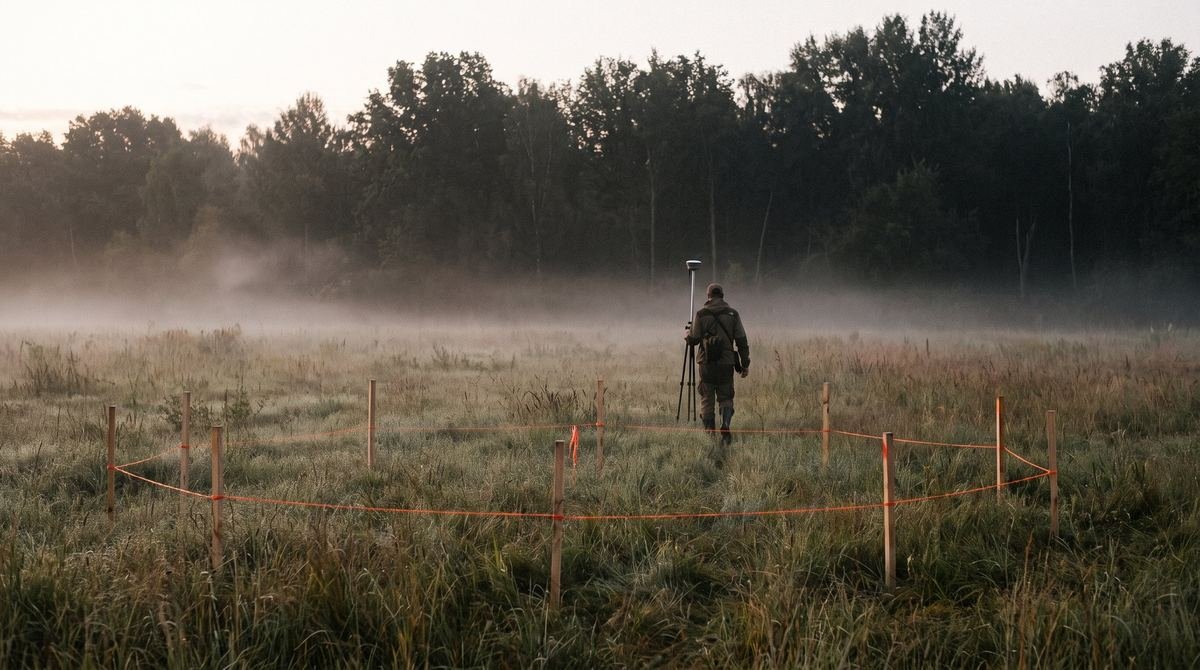
Assessing the plot is one of the first steps on the REEDOME journey and usually takes 2–4 weeks: we arrange the surveyor and assess land use, buildable area, distances, access and utilities. If you don't have a plot yet, we help you assess the options, so that you buy knowing what can be built there. Fill in our short questionnaire and tell us about the plot you have or are thinking of buying.
Tell us about your future dome and get a tailored proposal.