- REEDOME
- The dome guide
- Stage 2: Understand
- 1. Discover
- 2. Understand
- 3. Decide
- 4. The path
Why a geodesic dome is so strong: maths, nature and sacred geometry
 Visualisation
help@reedome.eu
+370 [JŪSŲ NUMERIS]
VisualisationA geodesic dome looks light, almost delicate, yet for its weight it is one of the strongest structures we know. The secret lies not in the material but in the geometry. Here is how it works, why similar forms appear in nature, and where sacred geometry fits in.
The word comes from geodesy, the science of measuring the Earth. A geodesic line is the shortest path between two points on a curved surface. On a sphere, that path always runs along a great circle: a circle whose plane passes through the centre of the sphere.
In a geodesic dome, each strut joins two points on the sphere by the shortest route, and together the struts cover the sphere in an even network. The result is almost round, even though every piece is straight.
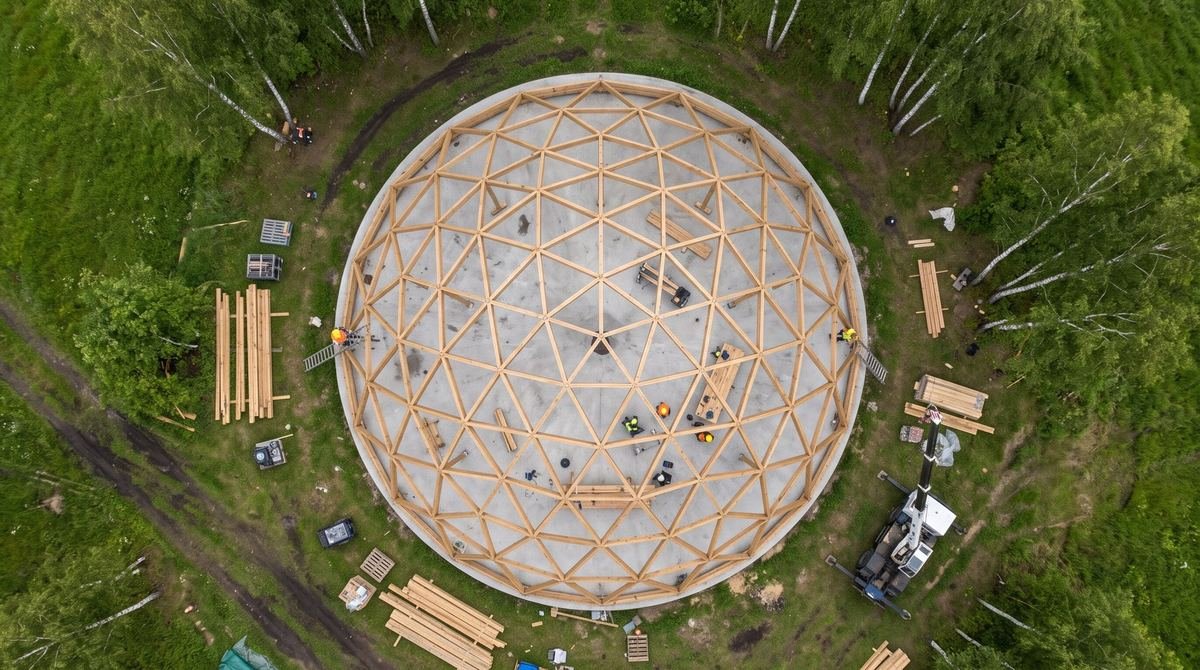
Most geodesic domes start from an icosahedron: a regular solid of 20 equilateral triangles, with 12 corners and 30 edges. To make it rounder, each triangle is divided into smaller ones and the new corners are moved out onto the surface of the sphere.
The number of parts each edge is divided into is the dome's frequency, written with a V. In a 3V dome each edge is split in three, so every original triangle becomes nine smaller ones. Higher frequencies mean more triangles, a rounder shape and shorter pieces, which is why larger domes usually use them.
At most joints of a geodesic dome six triangles meet and form a hexagon, but at some only five meet and form a pentagon. On a full sphere there are always exactly 12 of these pentagons, whatever the frequency: they sit at the corners of the original icosahedron.
This follows from Leonhard Euler's polyhedron formula: in any network of triangles covering a sphere, with five or six triangles meeting at each joint, exactly 12 joints will have five. A football, with its 12 pentagons, follows the same rule.
Of all polygons, only the triangle is rigid. Join four boards at the corners with hinges into a square and you can easily push it into a parallelogram without any board changing length. The angle of a triangle can only change if the opposite side stretches or shrinks.
That is why, in a network of triangles, the members work mainly in compression or tension rather than bending, so the material is used efficiently and the members can be light.
A dome carries three main loads: its own weight, snow and wind. In a geodesic dome, the load at each joint spreads into the neighbouring triangles and on through the whole network down to the foundation, instead of being gathered by a few beams and walls.
In practice this means:
Of all shapes, a sphere has the smallest surface area for a given volume. A house loses heat through its outer surface, so the less surface there is for each cubic metre inside, the less heat escapes. A dome is part of a sphere and inherits that advantage.
It saves material too. Shape alone does not make a home energy class A++, though: that also takes thick insulation, airtightness and ventilation with heat recovery.
Sacred geometry is an old cultural and philosophical tradition that looks for meaning and harmony in geometric forms. It is not a science, and we present it as culture rather than as an engineering argument. Still, it helps explain why domes feel special to many.
For viruses at least, science explains the resemblance simply: nature, like a good engineer, chooses the most economical solution. Sacred geometry reads it as a sign of a deeper order, and the two views can sit side by side.
Many people say they feel calmer under a dome. This is personal experience rather than a measured effect, and there are simple explanations: no corners, a high ceiling and light from above moving across the room. Some connect it with sacred geometry, others with a sense of shelter.
REEDOME builds only geodesic domes, from a Ø8 m dome of about 50 m² to connected Ø14 m and Ø8 m domes of about 230 m², thatched with 30–35 cm of hand-laid water reed and designed for energy class A++. To find out how this geometry feels in everyday life, fill in our short questionnaire and we will talk about your dome.
Fill in a short questionnaire. We'll answer your questions and suggest where to start.